Standardization in industrial metal 3D printing is excellent for stable, serial production, but it can quickly become a bottleneck for innovation. R&D engineers, universities, and advanced tooling departments need the freedom to experiment. This is where an open architecture LPBF (Laser Powder Bed Fusion) system becomes absolutely essential.
The Limitations of Closed-Parameter AM Systems
When users print similar products from standard metal powders on a closed system, complications are rarely expected because output quality remains consistent. However, problems immediately arise when a client requires a specific material with minor chemical variations compared to the base composition. Tests have shown that even a 2% difference in required laser power can significantly impact the mechanical properties of the final product.
Furthermore, using universal parameters makes it difficult to equally process both thin and thick walls. Thin walls can quickly overheat due to excessive energy input, while thicker objects absorb more energy and require a higher energy input for proper processing. An open system allows for the individual adjustment of standard process parameters to effectively address these thermal issues and adapt to new materials.
Key Process Parameters Unlocked by Open Architecture LPBF
Advanced LPBF platforms provide multiple levels of workflow access, from a strict production mode to a full R&D mode that allows parameter adjustment even during the preparation and generation of the print. The most critical parameters engineers must control include:
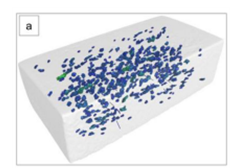
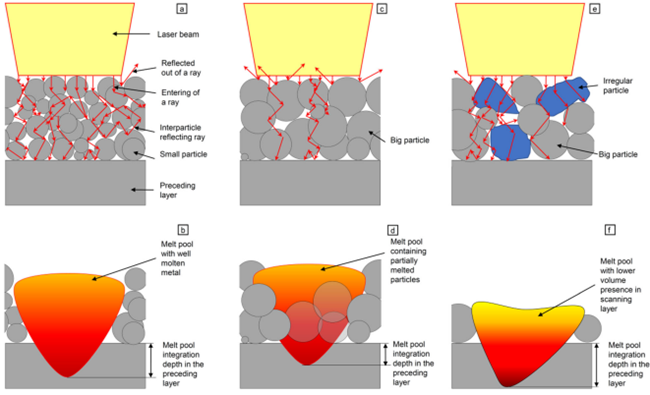
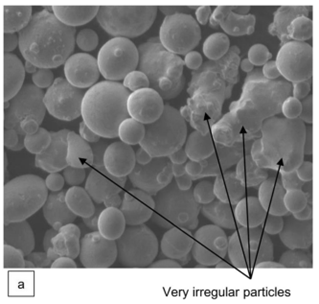
- Laser Power and Scanning Speed: These dictate the Volumetric Energy Density ($VED$). The formula relies on laser power ($P$), scanning speed ($v$), hatch spacing ($h$), and layer thickness ($t$). If the energy input is too low, the material becomes porous and fails to achieve the desired mechanical properties. Conversely, excessive energy causes material burning and plasma formation, trapping bubbles in the structure and creating soot and agglomerated particles that necessitate extensive powder cleaning. The goal is to ensure a homogeneous powder structure and uniform particle melting without overheating.
- Hatching Strategy Customization: The scanning strategy directly influences the material’s microstructure, residual stresses, and repeatability. Using the same scanning direction creates a highly anisotropic microstructure with elongated columnar grains in the direction of heat dissipation. Rotating the scanning direction between layers (e.g., by 67° or 90°) enables a more homogeneous microstructure, even grain growth, and isotropic mechanical properties. Strategies like island or chessboard scanning reduce the size of simultaneously heated areas, mitigating thermal gradients, warping, and cracking, though they require careful optimization to avoid localized defects at the island borders.
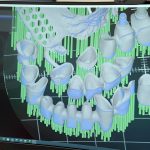
- Layer Thickness and Structural Adjustments: Layer thickness heavily impacts production speed and horizontal surface quality, though its effect diminishes on steeper vertical angles. Manual parameter adjustments are particularly beneficial for structural supports and the printing of top and bottom horizontal surfaces, areas where automated preparation algorithms often struggle to find the optimal setup.
Validating Custom Metal Alloys Safely
Unrestricted parameters allow for custom alloy development, which is crucial for high-tech research and medical applications, such as advanced orthopedics developed in collaboration with the University of Maribor. LPBF technology uniquely enables the successful combination of materials with vastly different melting points, circumventing the limitations and incompatibilities of classical metallurgical processes.
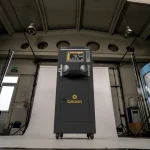
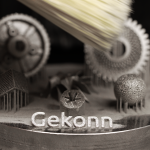
This validation phase requires uncompromising safety. Processing reactive metals like titanium (Ti6Al4V) or aluminum alloys (AlSi10Mg) demands a strictly controlled processing environment with inert gases (Argon/Nitrogen) and controlled oxygen levels to prevent oxidation. A closed-loop powder approach reduces environmental exposure and enhances operator safety. Additionally, utilizing an independent glovebox chamber allows all powder handling to occur safely under an inert gas atmosphere. For these demanding R&D tasks, open architecture LPBF platforms like the Gekonn LMP 100v3 metal 3D printer provide the necessary process control, powder stability, and validation capabilities.
Real-World Application: High-Pressure Valves
The necessity of open parameters is clearly evident when manufacturing complex multi-port valves for high-pressure applications. Achieving extremely low material porosity is critical, as seemingly isolated pores are often interconnected via the microstructure, leading to leaks and component failure under pressure. Standard parameters can mask these risks, especially in complex geometries with varying wall thicknesses and inclines. Individual optimization of process parameters is absolutely necessary to ensure adequate material density, a homogeneous microstructure, and structural integrity under load.
Bridging the Gap from R&D to Serial Production
Once parameters are successfully developed on a smaller open R&D system, they can be logically transferred to larger serial production platforms. While the core geometric settings often remain standardized across a machine family, differences in laser focus size directly affect energy density. Therefore, engineers typically only need to adjust the laser power, scanning speed, and hatch spacing to balance the energy distribution and ensure repeatability when scaling up from a smaller prototyping machine to a larger industrial platform.
Conclusion
For engineering teams seeking true innovation, locked parameters are a liability. An open architecture LPBF system provides the absolute process control required to safely push the boundaries of additive manufacturing, validate new alloys, and seamlessly scale into industrial production.